Sled dog
The Call of the WildSled dog is not merely a means of transportation in the Northland but a working participant in the region’s economy and survival. The dogs learn routes, commands, spacing, and cooperation; they endure hunger, frost, exhaustion, and injury; and they possess a powerful investment in the work itself. Through Buck’s experience, the sled dog appears as both an intelligent laborer and a life treated as expendable equipment, while the team’s discipline and solidarity make long-distance travel possible.
Nature and Training
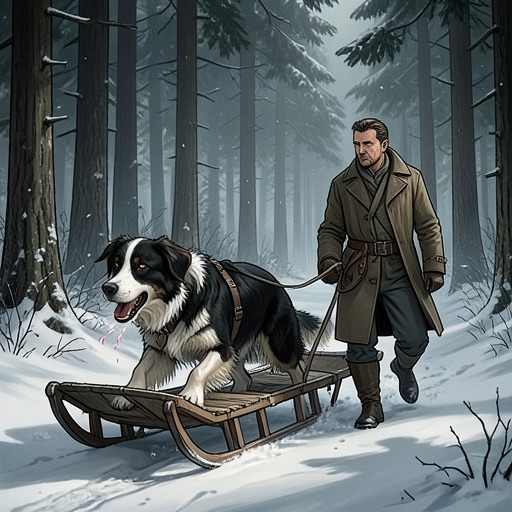
A sled dog works in a harness attached to a sled, responding to the driver’s commands and to the corrections of its team-mates. When Buck first enters this life, Francois fits him with straps and buckles and sets him to hauling a load of firewood. Dave, the experienced wheeler, nips Buck’s hindquarters when he makes a mistake; Spitz, the lead dog, growls reproof and throws his weight into the traces to force him into position. Francois’s whip supplies the human authority behind these lessons. Buck quickly learns to stop at “ho,” go forward at “mush,” swing wide on bends, and keep clear of the wheeler when a loaded sled rushes downhill behind him. The team’s instruction is practical rather than gentle. When Buck becomes tangled in the traces and delays departure, Dave and Solleks attack him until he learns to keep the lines clear. The punishment is immediate, but it also transmits essential knowledge: a dog that cannot maintain its place endangers the movement of the entire sled. Buck’s rapid progress reduces both the nipping of his companions and the frequency of Francois’s whip, and Perrault rewards his improvement by lifting and examining his feet, an action that recognizes the feet as crucial working instruments.
Team Structure and the Pride of Harness
A sled-dog team has a functional hierarchy. In Buck’s first arrangement, Dave serves as wheeler, Buck runs ahead of him, Solleks follows Buck, and the remaining dogs extend in single file toward Spitz, who occupies the lead position. Buck is deliberately placed between experienced dogs so that he can learn through constant contact. The arrangement depends on differentiated skills rather than simple strength: the leader directs the line, the wheeler manages the sled’s immediate pull, and each dog must preserve its place and tension in the traces. Harness changes the dogs’ whole manner. Dave and Solleks, passive and unconcerned when loose, become alert, active, and fiercely irritated by delay or confusion once attached to the sled. The work seems to them the supreme expression of their being. They are transformed from sullen animals into straining, ambitious workers at the breaking of camp, then collapse into gloomy unrest when the day’s labor ends. Buck gradually experiences the same force. Though the work is hard, he discovers that the team’s eagerness passes into him, and he begins to take pride in doing his share. This pride explains both the team’s endurance and its conflicts. It makes Spitz punish dogs that shirk or hide at harness-up time, and it makes him fear Buck as a possible lead dog. It also gives the labor a psychological intensity beyond obedience: the dogs do not merely pull because humans compel them; they are drawn by the pride of trace and trail, a need that can make removal from the harness feel like exclusion from life itself.
Routes, Loads, and Sustained Labor
The sled dogs carry government dispatches and later transport mail, linking distant camps and mining settlements across a landscape where ordinary travel is dangerous or impossible. Buck’s first major run takes the team up the Yea Canyon, through Sheep Camp, past the Scales and the timber line, across glaciers and deep snowdrifts, and over the Chilkoot Divide between salt water and the Northland’s interior. They descend the chain of lakes to Lake Bennett, where thousands of gold-seekers are building boats for the spring breakup. The schedule is relentless. The dogs break camp in darkness, reach the trail at first gray light, eat their ration of fish, and return after nightfall to holes in the snow. Buck receives a pound and a half of sundried salmon each day, yet hunger remains constant; the lighter dogs receive only a pound and stay in better condition because they are born to this work. The strain becomes visible in his habits. Once a dainty eater, he begins eating rapidly so that companions cannot steal his unfinished food, and then learns to steal for himself. The dog team’s labor therefore changes not only the body but also the conduct of the dog, replacing the former rules of private property and personal feeling with the Northland’s harsher law of survival. The route exposes both dogs and drivers to environmental risk. On the Thirty Mile River, open water resists the frost, while only eddies and quiet places hold ice. Six exhausting days are needed to cover the thirty miles. Perrault repeatedly breaks through ice bridges and must use his long pole to survive, while a temperature of fifty degrees below zero forces him to build fires and dry his clothes. A sled carrying Dave and Buck also breaks through; both are nearly drowned and half-frozen before the men drag them out and keep them running around the fire until they thaw. The dogs’ transport labor is thus inseparable from ice knowledge, human judgment, and repeated exposure to death. After the record journey to Skaguay, during which the team averages forty miles a day for fourteen days, the dogs are sent back with the mail train. The return is slower because the load is heavy, but the work is just as necessary: the mail carries news from the wider world to men searching for gold under the shadow of the Pole. Camp follows a machine-like routine of cooking, harnessing, breaking camp, cutting firewood, preparing beds, carrying water or ice, feeding the dogs, and moving again. More than a hundred dogs may gather around camp, yet the same basic order governs them all: labor, food, brief social rest, and renewed labor.
Injury, Exhaustion, and Death
The sled dog’s working identity can become so complete that illness and removal from the traces feel like a personal catastrophe. Dave, a veteran wheel-dog, grows sick and repeatedly falls in harness. At Cassiar Bar, the Scotch half-breed removes him from the team and fastens Solleks in his place, intending to let Dave follow freely behind the sled. Dave resists the change, growling during the unfastening and crying when he sees another dog occupying the position he has served for so long. Dave refuses the easier path behind the sled and struggles through soft snow alongside the trail, attacking Solleks and trying to force his way back between the dog and the sled. When he finally reaches his own team again, he bites through both of Solleks’s traces and stands in his proper place, pleading with his eyes to be allowed to work. The men understand that a dog may break its heart when denied the labor that is killing it. They harness Dave again so that he may die contentedly in the traces, though he repeatedly cries from his internal injury, falls, is dragged, and is run over by the sled, leaving him lame in one hind leg. Dave’s last morning reveals the terrible cost of this identification with work. Too weak to travel, he crawls toward the harnesses being placed on his companions, advancing his forelegs and hitching the rest of his body forward a few inches at a time. He collapses in the snow still yearning toward the team. The train halts, the driver returns behind the river timber, and a revolver shot confirms what Buck and every other dog already understands. The work that gave Dave purpose also becomes the setting of his death. The larger team suffers the same prolonged depletion. In less than five months, Buck and his companions travel twenty-five hundred miles, including eighteen hundred miles with only five days of rest. By the time they reach Skaguay, Buck’s weight has fallen from one hundred and forty pounds to one hundred and fifteen. Pike limps in earnest after once feigning injury, Solleks limps, Dub has a wrenched shoulder blade, and all are terribly footsore. Their steps lose all spring and rebound; every footfall jars an already exhausted body. This is not brief fatigue recoverable in hours but the slow drainage of every reserve: muscle, fiber, and cell are spent, and the dogs can barely keep the traces taut or avoid the sled on downhill stretches.
Ecological and Narrative Significance
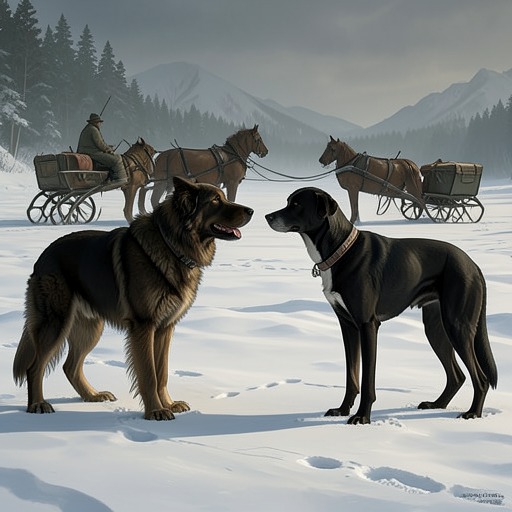
The sled dogs belong to a moving network that joins human commerce to seasonal change. Their routes cross glaciers, unstable rivers, mountain divides, and lakes altered by freezing and thawing. In spring, while sunlight lengthens and the Yukon strains against its ice, the surrounding world bursts into renewed life: sap rises, buds open, insects emerge, birds return, and water begins to flow. Against that abundance, the dogs and their human companions stagger toward exhaustion, showing how the transport system can remain locked in its schedule even when the ecological season has changed around it. The dogs also stand at the threshold between domesticated labor and wild animal life. Their harness discipline makes communication and long-distance transport possible, but their intelligence, appetite, rivalries, fatigue, and attachment to work prevent them from being reduced to inert tools. In Buck’s development, the sled dog’s discipline becomes training for a broader transformation. He learns the endurance, cunning, and violence required by the Northland, then carries those capacities into hunting. Later, in the forest, he can stalk ptarmigan, rabbits, chipmunks, fish, and beaver, and he desires increasingly formidable quarry, culminating in the pursuit of a great bull moose more than six feet high. The final contrast is between the organized team and the wolf pack. After John Thornton’s death, Buck no longer has a human claim binding him, and a wolf pack enters his valley while hunting migrating moose. Buck faces the pack alone, kills the first attacker by breaking its neck, repels three more, and holds his ground for half an hour from a position protected by a gravel bank. When the wolves withdraw, a long, lean gray wolf approaches in friendship; Buck recognizes the wild brother with whom he once ran and touches noses with him. The sled dog thus occupies a decisive middle position in the story: shaped by human harness and labor, but capable of carrying the knowledge of that discipline into an older, freer order of hunting and pack life.